A Call to Action to Refer Early Across Diverse Healthcare Settings
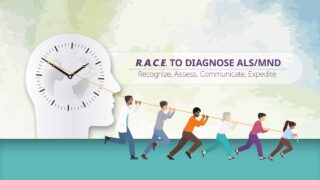 R.A.C.E. to Diagnose ALS/MND is an education and awareness initiative designed to help healthcare professionals recognize the early signs and symptoms of ALS/MND and support earlier referral and diagnosis.
How can you use the resources?
- Individual self-study: Use the resources to build your own knowledge and confidence in recognizing possible signs of ALS/MND.
- Organizational learning: Use the training materials within your organization for education and awareness sessions with colleagues.
- Faculty-led sessions: Request support from the R.A.C.E. to Diagnose ALS/MND faculty to deliver an education session for your team or organization. Conditions and faculty availability apply. For more information or to book a session, email education@als-mnd.org.
- Conference and event outreach: Use the program flyer or training materials as part of proactive education and awareness activities at conferences, meetings and other professional events.
- Online learning: Incorporate the content into existing online education programs and learning platforms.
This project was initiated and funded by My Name’5 Doddie Foundation.
Founded by Scottish rugby legend Doddie Weir, My Name’5 Doddie Foundation funds bold ideas, invests in leading researchers, and works to find the fastest routes to treatments and a cure for MND.
Learning objectives
- Recognize the early signs and symptoms of ALS/MND across diverse healthcare settings and specialties
- Assess clinical features and initiate appropriate investigations, if warranted, without delaying referral
- Communicate the need for an urgent onward specialist referral to those with suspected ALS/MND
- Expedite referrals, even in the absence of complete diagnostic confirmation, and ensure referral letters clearly communicate key clinical findings to support triage
Resources
Download the materials below to use the program, share it with your team or support participants after the training.
PowerPoint Slides (PPTX) — Full slide deck, available to download and adapt to suit your audience
Participant Handout (PDF) — A reference resource for participants, summarizing key information from the content
Program Flyer (PDF) — A two-page, print-ready summary of the R.A.C.E. protocol, key red flags, and how to access the course
Invitation – Virtual Event (PDF) — A ready-to-use invitation template for promoting a virtual educational event
Invitation – Live Event (PDF) — A ready-to-use invitation template for promoting an in-person educational event
Evaluation Form (PDF) — For participants to complete after the session
Speaker Guide (PDF) — Facilitator notes for preparing and delivering the content
Certificate (with speaker) (PDF) — Certificate template that acknowledges the faculty member delivering the session
Certificate (PDF) — Certificate template for participants following session completion
Sign-in Sheet (PDF) — A sign-in template for recording attendance at an educational session
Videos
Watch the full R.A.C.E. to Diagnose ALS/MND program and selected videos exploring diagnostic experiences, referral delays and key clinical considerations.
Faculty Recording of the R.A.C.E. to Diagnose ALS/MND Program
Watch the full faculty-led recording of the R.A.C.E. to Diagnose ALS/MND program.
Person Living with ALS/MND Sharing His Diagnostic Journey
Craig Reyenga, a person living with ALS/MND, shares his challenging diagnostic journey and the difficulties he faced throughout the process.
Overcoming Therapeutic Nihilism in ALS/MND
Professor Orla Hardiman (BSc, MB, MD, FRCPI, FTCD, MRIA) addresses the misconception that ALS/MND referrals are futile, stressing that multidisciplinary clinics significantly improve quality of life, offer access to research and emerging therapies, and provide meaningful hope for patients.
The Cost of Delayed Diagnosis: Personal Stories from the Faculty
Members of the faculty present cases they have encountered that highlight the real-world impact of diagnostic delays in ALS/MND.
Professor Orla Hardiman, BSc, MB, MD, FRCPI, FTCD, MRIA
Ms. Marla Calder, BScOT
Professor Christopher J. McDermott, PhD, MD, FRCP
Professor Nortina Shahrizaila, DM, PhD, FRCP
Recap: When to Suspect ALS/MND and Refer
Professor Nortina Shahrizaila (DM, PhD, FRCP) summarizes key red flags for ALS/MND, such as a progressive, painless loss of motor function or unexplained weight loss with breathing difficulty, and emphasizes the need for immediate referral when symptoms do not fit typical patterns.
Avoid Diagnostic Pitfalls: Prioritize Urgent Referrals
Professor Orla Hardiman (BSc, MB, MD, FRCPI, FTCD, MRIA) advises non-specialists to refer suspected ALS/MND cases promptly rather than ordering exhaustive tests, noting that early referral prevents delays, reduces unnecessary costs, and ensures patients access specialized evaluation.
Craig’s MRI Maze: A Journey Through Missed Opportunities and Delayed Referral
Craig Reyenga reflects on his prolonged diagnostic process and how delays left him uncertain about how to live his life and plan for the future, wishing he had been referred to a specialist sooner.
Faculty Perspective: Frustration with Referral Delays
Professor Christopher J. McDermott (PhD, MD, FRCP) discusses the frustration of receiving late referrals for ALS/MND patients, emphasizing how waiting for diagnostic certainty delays care, support, and access to clinical trials. He urges clinicians to refer early if ALS/MND is even a possibility.
From Diagnostic Uncertainty to Clarity: Insights from the Voices of People Living with ALS/MND
Two people living with ALS/MND share their journey, describing the impact of not having a diagnosis and how they felt once it was confirmed.
Ms. Leanne Sklavenitis
Mr. Bruce Virgo
What If the Patient Asks: “Could This Be ALS/MND?”
Ms. Marla Calder (BScOT) explains how allied health professionals should respond when patients raise concerns about serious conditions — by being honest, supportive, and ensuring prompt referral and clear documentation rather than attempting to diagnose.