Background
In 1993, mutations in the cytosolic copper-zinc superoxide dismutase 1 (SOD1) gene were discovered to be associated with ALS (Rosen et al., 1993) accounting for roughly 2% of all ALS cases and approximately 15-20% of ALS/MND with familial history. The SOD1 gene contains the instructions needed to produce the SOD1 protein, an abundant enzyme within cells that serves to keep them safe from metabolic waste. Mutations in the SOD1 gene cause an accumulation of defective SOD1 protein in patients’ cells. These defective proteins create a toxic environment and result in motor neuron death (Bunton-Stasyshyn et al., 2014).
Qalsody is an antisense oligonucleotide (ASO) directed against SOD1 messenger RNA (mRNA), which encodes the SOD1 protein. By targeting the SOD1 mRNA, this ASO reduces the overall expression of the SOD1 protein, limiting its toxic activity in people with SOD1-ALS. Qalsody is administered through an injection in the spinal fluid (intrathecally) every 28 days (Ref: FDA). More information on trial design and outcomes that determined FDA approval can be found here.
To date the US Food and Drug Administration (FDA), Health Canada, the UK Medicines and Healthcare products Regulatory Agency (MHRA), the Australian Therapeutic Goods Administration (TGA) and the European Medicine Agency (EMA) have granted approval to Qalsody (tofersen) to treat patients affected by ALS associated with a mutation in SOD1 (SOD1-ALS).
The Atlas Trial
Early intervention has long been considered as likely optimal in ALS/MND, though it has never been clinically tested. The ability to initiate experimental and proven treatments upstream of clinical symptom onset is a milestone that requires a biological indicator (biomarker) of underlying disease processes being triggered.
In recent years, a significant amount of work has yielded the protein called neurofilament light chain (NfL) as a potential blood biomarker to indicate that nervous system damage has occurred. While this is not specific for ALS, when combined with known, disease-causing genetic mutations, it may provide an opportunity to visualize the pre-clinical triggering of ALS/MND processes.
Given tofersen’s efficacy and safety profile, and the hypothesized advantage of early therapeutic intervention in ALS/MND, Biogen started a global pre-symptomatic trial in ~150 individuals who carry selected SOD1 mutations linked to rapid disease progression but have not yet shown any ALS symptoms. This is a Phase 3 randomized, placebo-controlled trial, and results are expected in 2027. The leading hypothesis for this trial is that by reducing production of toxic SOD1 protein in people with SOD1 mutations, the drug will either delay symptoms from appearing or prevent symptoms altogether. Participants are monitored monthly for change in ALS Functional Rating Scale (ALSFRS-R) total score, change from baseline in percent predicted Slow Vital Capacity (SVC), adverse events and plasma and CSF-based biomarkers. Specifically, participants are monitored monthly for any change in plasma-based biomarkers called neurofilament light (NfL), which indicates early stage of disease up to a year prior to symptom onset. All individuals on placebo will be provided open label tofersen upon an ALS diagnosis, which still results in earlier access to the treatment than any of the individuals affected by SOD1-ALS treated to date.
The novel primary measure of evaluation will be the proportion of participants who develop clinical symptoms of ALS/MND within one year of randomization. Given that the participants will have SOD1 mutations associated with rapid progression, if a significant number do not have clinical symptoms after one year, it would suggest that tofersen is able to delay the disease process. Participants will be treated for up to two years as part of the study.
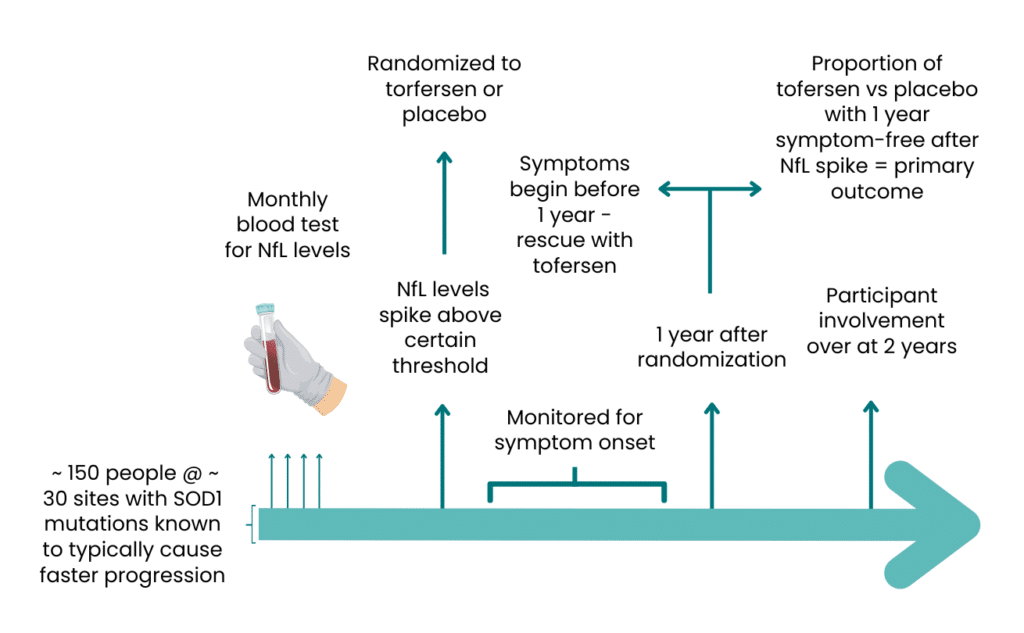
Fig1. ATLAS trial design overview
It is hoped that the ATLAS trial will pave the way for more pre-symptomatic trials in the future. Should therapies become proven as effective for other known genetic mutations, these pre-symptomatic studies may indicate the next logical step and will have learned from ATLAS in the effectiveness of using NfL as a trial initiation biomarker in practice.
For cases where there is no identifiable mutation in a known ALS gene, researchers will need to identify additional biomarker(s) that can differentiate between nervous system damage indicating ALS versus that of many other conditions. As of 2026, there is nothing fitting this criterion that is close to clinical use, but a strong effort is underway in labs around the world.
More recently, Washington University School of Medicine, in collaboration with Biogen, has initiated a clinical trial with the goal to evaluate whether tofersen is safe and effective in people with non-SOD1 ALS. It will be an open-label study at a single site in the USA and will include 30 people with ALS. The study will evaluate whether tofersen will reduce NfL, is safe and tolerable, and modify clinical outcomes and quality-of-life measures in people with non-SOD1 ALS.
Other SOD-1 Targeting Therapies
In addition to the above, other companies are developing more therapeutics to target SOD1 as well.
- UniQure has developed a one-time intrathecally administered gene therapy (AMT-162), composed by a viral vector (AAVrh10) that expresses a micro ribonucleic acid (miRNA) designed to decrease the expression of SOD1. In 2024, the FDA cleared the investigational new drug (IND) application for AMT-162 and granted Orphan Drug and Fast Track designations. UniQure announced that the first patient had been dosed in October 2024 for a Phase 1/2, multi-center, three-part study (called EPISOD1). In January 2025, it was announced that the Independent Data Monitoring Committee recommended moving forward with a dose escalation study after the first dose was deemed safe. In October 2025, UniQure put a voluntary hold on further recruitment issuing the following statement:
“Enrollment remains on voluntary pause following the Independent Data Monitoring Committee recommendation after review of preliminary safety and efficacy data in September 2025, which included one serious adverse event of dose-limiting toxicity determined to be related to AMT-162. The Company continues to collect and evaluate data from the five patients treated in the Phase I/II EPISOD1 study.”
- In 2022, Alnylam Pharmaceuticals published a novel small interfering RNA (siRNA) technology to enhance delivery to the central nervous system (CNS). They showed uptake of SOD1 targeting siRNA in the CNS and subsequent lower expression of SOD1 by 75% in a mouse model system. Alnylam is collaborating with Regeneron to move this program forward. Regeneron initiated a phase 1/2 safety and tolerability study of the drug ALN-SOD in SOD-1 ALS in 2024 that is currently recruiting at multiple sites in Australia, Canada, Belgium, Japan, Taiwan and South Korea.
- AviadoBio has recently acquired rights for Neurgian Technologies’ novel approach to deliver gene therapies directly to the spinal cord through a ‘subpial’ injection. This technique enables the drug to get through the membrane that surrounds the spinal cord, resulting in lower dose requirements for treatments and a minimally invasive procedure. AviadoBio is aiming to use this method to deliver a short hairpin RNA (shRNA) directed against SOD1 to repress gene expression. Neurgian Technologies showed that in rodents one subpial injection with a virally delivered shRNA resulted in the prevention of the disease in SOD1 carriers and improvement of the disease in symptomatic mice. In pigs and non-human primates, one injection produces homogeneous delivery in the whole spinal cord. This approach is still in the preclinical phase currently.
- Insmed is developing INS1202, gene therapy designed to target and reduce toxic SOD1 levels using an adeno-associated virus-based (AAV) approach. Preclinical studies showed success in iPSC cells derived from ALS patients. Insmed launched the first-in-human phase 1 ARMOR trial (NCT07290062) in March 2026 to assess safety, tolerability, proof of principle and dose-selection and is currently recruiting in the US at multiple sites.
- Ractigen Therapeutics, are developing a siRNA therapy targeting SOD1 which needs only a single injection to obtain sustained knockdown of the target gene. Initial results from two phase 1 clinical trials reported at the American Academy of Neurology (AAN) 2026 annual meeting showed the drug was well tolerated at multiple doses. They also claimed rapid, sustained reductions in CSF SOD1 and plasma NfL although the data have not been published to allow scrutiny of this claim. The Phase II stage of the study is ongoing at multiple sites in China.
- AL-S Pharma, based in Switzerland, is advancing AP-101, a first-in-class antibody designed to deplete misfolded SOD1 in both sporadic ALS and SOD1-ALS. AP-101 binds selectively to the misfolded, toxic form of SOD1 and helps the body’s immune system clear these harmful proteins. A global, randomized, double-blind, placebo-controlled Phase 2 trial evaluating the safety, tolerability, pharmacodynamic markers, and pharmacokinetics (PK) of AP-101 in 73 participants (52 sporadic ALS and 21 mutant SOD1 ALS) was completed in 2025. Topline results were presented at the International Symposium on ALS/MND with additional results presented at the AD/PD™ 2026 International Conference on Alzheimer’s and Parkinson’s Diseases. The trial met its primary endpoint related to safety and tolerability. They also stated that clinically meaningful disease modification and prolonged survival supported by reductions in key neuroaxonal injury biomarkers, serum neurofilament light chain (NfL) and cerebrospinal fluid phosphorylated neurofilament heavy chain (pNfH) were seen after six months of treatment. The data have yet to be published. AL-S Pharma is currently preparing for a confirmatory Phase 3 clinical trial of AP-101 in ALS aimed to initiate end of 2026.
Summary
Therapies that lower the total amount of SOD1 are believed to be an effective strategy against SOD1-ALS. It is expected that we will see an optimization of these therapies, such as earlier intervention or improvement of drug delivery to the CNS. There is still much to learn about the long-term implication of lowering SOD1 levels and to what extent it can safely be lowered. Furthermore, strategies to lower only the abnormal SOD1 are also a possibility, which would be more specific to SOD1 toxicity in ALS.
It is important to note that there are many areas of the world where tofersen is not a therapeutic option due to different reasons. We hope that as more SOD1 targeting therapies are developed, this will give individuals affected by SOD1-ALS an option to receive the new SOD-1 targeting therapeutics through clinical trials. The Alliance is actively working to create clinical trial networks in geographic regions where they do not already exist to facilitate the diffusion of promising therapies without geographic restrictions.
To date, therapies that lower the total amount of SOD1 protein have only been tested in individuals affected by SOD1-ALS or preclinical models of SOD1-ALS. Therefore, none of the therapies mentioned here are currently indicated for people with ALS who do not carry SOD1 genetic variants. Tofersen is the only approved drug specifically for the treatment of people affected by ALS/MND associated with a genetic variant in SOD1.
International Alliance of ALS/MND Associations
April 2026
Disclaimer: Consult with a healthcare professional to determine if you could potentially participate in a SOD1 clinical trial. Always disclose your medical history, including any drugs, natural supplements, or herbal medicines currently being used.
The original language of communication is English and any translation cannot be guaranteed for accuracy of messaging.